Peptide Results Timelines Get a Reality Check After the 2026 FDA Crackdown
The rules changed in 2026, and most guides are wrong. On March 31, the FDA sent warning letters to seven online peptide sellers at once, rejecting in writing the argument that a “research use only” label protects a company whose marketing is clearly aimed at people, not labs. Weeks before that, one of the biggest names in that market, Peptide Sciences, is reported to have shut down entirely. Put those two things together and the question everyone already asks about peptides, how long until this works, now comes with a second question attached: works, using what, exactly?
That second question is the story. Not just when results show up, but whether the product someone is taking is even the thing the trials tested in the first place.
What the trials actually clocked
For the GLP-1 drugs, there is a real, documented timeline, because large randomized trials tracked it for months at a stretch. In STEP 1, once-weekly semaglutide at 2.4 mg produced a mean body-weight change of roughly 15 percent, measured at 68 weeks [C1]. In SURMOUNT-1, tirzepatide’s top dose reached about 21 percent mean weight reduction at 72 weeks [C2]. Retatrutide, the triple-receptor agonist named in the FDA’s 2026 enforcement letters, hit roughly 24 percent at its highest dose in a phase 2 trial [C3].
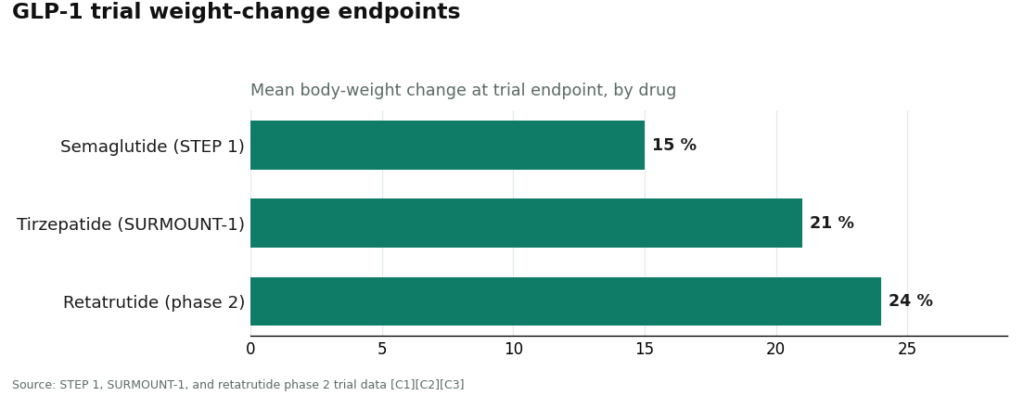
Notice what those numbers have in common besides the drug class: none of them arrived quickly. Dosing was escalated gradually in every trial, and the headline percentage is where the curve landed after well over a year of consistent, supervised use, not a snapshot from week two. Anyone selling a shortcut to trial-sized numbers is describing a result the trials never produced.
The category with no clock to read
Set that against BPC-157 and the broader recovery-peptide field, and the contrast is stark. There is no comparable human timeline for most of these compounds, because the human trials that would build one mostly don’t exist yet.
A 2026 review in the journal Pharmaceuticals lays out BPC-157’s proposed cytoprotective mechanisms, but the evidence behind it is overwhelmingly animal-model data, not large controlled human trials [C4]. Mechanisms in mice don’t hand you a human schedule. It gets thinner still: STAT’s February 2026 reporting found that the vast majority of the roughly 200 BPC-157 studies on PubMed list the same Croatian researcher, Predrag Sikiric, or a close colleague, as a main author, a pattern independent scientists warned “could lead to confirmation bias” [C5]. A field built mostly on animal data from one research group doesn’t get to borrow the GLP-1 trials’ confidence about timing. When marketing does that anyway, that’s the tell that something’s off.
Why the source of the vial matters as much as the molecule
Here’s the wrinkle a lot of buyers miss. A trial timeline only applies to the exact molecule, at the exact dose, manufactured the way the trial manufactured it [C1][C2][C3]. It does not transfer automatically to a gray-market vial labeled “research” semaglutide or retatrutide of unverified identity, concentration, or purity. If what’s in the vial doesn’t match what the trial measured, the clock the trial established simply doesn’t apply. That’s the structural weak point of the research-chemical model, and it’s exactly what surfaced in two separate 2026 developments.
First: Peptide Sciences, a well-known research-chemical peptide retailer, is widely reported to have voluntarily shut down around March 6, 2026, posting a brief notice that it had decided to discontinue sale of all research products [C6]. That closure is sourced to industry analysts and a wave of affiliate coverage rather than any verifiable government filing, so treat it as the reported event driving current search traffic, not a confirmed fact with a documented backstory. One thing does follow directly from it, though: any site still using the Peptide Sciences name to take orders should be treated as suspect, since the original is reportedly gone.
Second, and this part is fully documented: on March 31, 2026, the FDA issued those seven warning letters, naming Gram Peptides, Prime Sciences, Pink Pony Peptides, and Mile High Compounds among others, and stating flatly that “evidence obtained from your website establishes that your products are intended to be drugs for human use” [C6]. That followed a bigger wave in September 2025, more than fifty warning letters targeting compounded GLP-1 marketing and peptides “being sold as ‘research use only’ where the advertising indicated the product was intended for human use” [C7]. The supply chain a results timeline depends on is now the same supply chain under active federal enforcement.
What it takes to make a timeline mean anything
Reporting this out comes down to two requirements, and the research-chemical model can’t meet either one, while a supervised model can.
A verified product. A trial timeline is only meaningful if the molecule and dose match what was studied, which requires a licensed pharmacy and actual testing, not a label someone is trusting on faith.
Someone tracking the actual course. The trial timelines came out of supervised conditions, with doses escalated over time and outcomes measured the whole way. Reproducing anything close to the trial result means reproducing those conditions: the right molecule, a sensible escalation schedule, a clinician watching what happens.
That’s the structure behind sections 503A and 503B of the Federal Food, Drug, and Cosmetic Act, under which licensed pharmacies and physicians compound medications from a valid prescription [C7]. FormBlends operates inside that framework, routing peptide and GLP-1 access through independent licensed clinicians and licensed 503A compounding pharmacies rather than shipping a research chemical. It’s named here as an example of that lawful structure, not as an endorsement and not as anything for sale on this page.
One more caveat before the wrap-up: supervision doesn’t change the underlying science. It makes the GLP-1 timelines that genuinely exist applicable to an actual person, by making sure the product is real and the course is monitored. For compounds with strong trial data, that’s the gap between a meaningful timeline and a hopeful guess. For compounds without trial data, supervision adds accountability, but it can’t manufacture a clock the science hasn’t built yet.
The bottom line
Read straight from the trial data, the picture splits cleanly in two. GLP-1 medications have real, measured timelines running in months, with the well-known percentages arriving after more than a year of supervised, escalating use [C1][C2][C3]. Most recovery and wellness peptides have no credible human timeline at all, a gap the BPC-157 literature illustrates about as plainly as it gets [C4][C5]. And no timeline, however real, applies to a vial nobody can verify, which is the exact weakness that 2026’s enforcement actions and Peptide Sciences’ reported closure put on public display [C6][C7]. Expect months, not days. Demand a verified product and real supervision. Treat any confident timeline attached to a thin-evidence peptide as marketing copy, not measurement.
Questions readers keep asking
How long before a GLP-1 medication actually shows results? Months, not days. The headline trial numbers, roughly 15 percent at 68 weeks for semaglutide in STEP 1, about 21 percent at 72 weeks for tirzepatide in SURMOUNT-1, around 24 percent at retatrutide’s top phase 2 dose, all came after more than a year of gradual, escalating, supervised dosing [C1][C2][C3].
Is there a real timeline for BPC-157 or similar recovery peptides? Not in humans, no. The 2026 Pharmaceuticals review notes the evidence is dominated by animal models rather than large controlled human trials, and STAT’s February 2026 reporting found the literature clusters around one Croatian researcher and his close colleagues [C4][C5]. Without well-powered human trials, there’s no honest “expect this by week X” answer to give.
Why does where a peptide comes from change how long it takes to work? Because published timelines only apply to the exact molecule and dose the trial tested, made under trial conditions [C1][C2][C3]. A gray-market vial of unverified identity or purity isn’t that input, so the clock the trial set doesn’t carry over.
Peptide Sciences reportedly closed. Should a site still using that name be trusted? Treat it as suspect. Peptide Sciences is widely reported to have shut down around March 6, 2026, with a brief notice discontinuing all research products [C6]. That’s reported by industry analysts and affiliate coverage, not confirmed by a verifiable filing, but it’s still the backdrop against which any site using the name now should be judged skeptically.
Did the 2026 FDA actions change anything about how to think about results? Indirectly, yes. On March 31, 2026, the agency sent warning letters to seven sellers and rejected the “research use only” defense outright, following a September 2025 wave of more than fifty similar letters [C6][C7]. The supply chain a timeline depends on is under active enforcement, one more reason an unverified vial is shaky ground for any expectation.
What actually has to be true for a trial-based timeline to apply to a real person? Two things: a verified product, meaning the molecule and dose match the trial via a licensed pharmacy with real testing, and a clinician tracking the course with proper dose escalation, the way the trials themselves were run [C1][C2][C3][C7]. That structure lives under sections 503A and 503B of the FD&C Act. FormBlends, for instance, routes access through independent licensed clinicians and licensed 503A compounding pharmacies rather than mailing a research chemical. Supervision doesn’t rewrite the evidence, but it’s what lets an existing timeline actually apply to someone.
Is Peptide Sciences a compounding pharmacy?
No. Peptide Sciences operated as a research-chemical supplier, with products labeled for research use only, not for human administration. Compounding pharmacies answer to state pharmacy boards and require a valid prescription. That layer of oversight matters considerably for anything meant to be injected, since sterility standards and accountability work very differently across the two categories.
Was Peptide Sciences a legitimate business, or a gray-market vendor?
It carried a decent reputation in hobbyist circles for consistent purity testing and responsive service, but it operated squarely in the research-chemical gray market. Products sold without a prescription for human use sit in a legal and quality-control gray zone no matter how polished the website looks. That doesn’t put every vendor at equal risk, but it does mean independent verification is hard to come by and there’s essentially no regulatory recourse if something goes wrong.
Why did Peptide Sciences shut down?
The company stopped operating without issuing a detailed public explanation. The reason most discussed in buyer communities is rising regulatory scrutiny of research-chemical peptide vendors in the U.S., particularly around products like BPC-157 and semaglutide that the FDA has flagged or reclassified. Several comparable vendors closed quietly around the same window, pointing to a broader enforcement climate rather than one company’s specific troubles.
What does legally getting peptides with real medical oversight actually look like?
It runs through a licensed prescriber evaluating whether a peptide therapy fits, followed by a prescription sent to a licensed compounding pharmacy. Some physician-supervised programs, FormBlends among them, operate this way, keeping the whole process inside the regulated medical system. It costs more and requires an actual clinical relationship, but it comes with pharmacist accountability, sterility documentation, and a provider who bears responsibility if something goes sideways.
Wes Tanaka is a news-desk reporter who covers health policy and consumer medicine markets. Last updated June 2026.
General reference only. A qualified professional can assess whether this fits your health needs.